

Make A Phenology Wheel: Collect Your Observations
I’ve recently started using phenology wheels to make small daily observations and watercolor paintings. Today I'm sharing how to make your own wheel, along with some of the history and significance behind them. I love the practice of pulling out my watercolor paints for a few minutes each evening to capture what I noticed that day. Living in California where our seasonal changes are more subtle, it can feel like seasons don't exist here, but when I take the time to notice and chart, I see the small differences that mark the cycle.
Using a wheel to track events like the weather, seasonal plants, or bird sightings is not only a comforting and meditative practice but also contributes to a body of knowledge about the natural history of a specific time and place. It reminds me of those cool nature cabinets made from old type drawers; tiny elements of nature organized side by side turn into an amazing piece of art.

Phenology wheels allow you to make your own nature collection cabinet without taking anything from nature, only your notes and drawings. I love the look of the little sections of the wheel filling up with my collection for the month or year. The best part is, you can collect things that would be impossible to take physically. Collect sunsets, seasonal colors, or clouds. Even puddles! (Anyone else read The Puddle Pail by Elisa Kleven as a child?) Your wheel becomes an art piece, a diary, and a personal collection. You can display them on a wall or bind them into a book.
What is Phenology?
According to the USA National Phenology Network, “phenology is the study of the timing and cyclical patterns of events in the natural world, particularly those related to the annual life cycles of plants, animals, and other living things.”
Studying phenology gives scientists insights into the impacts of climate change, showing the cascading effects of global warming on different ecosystems (including our human ecosystem). It can also help to create more effective conservation strategies by helping scientists to understand what’s really happening, and if our efforts are having the desired effect. Indigenous cultures have a long history of connection to phenology, using observations of nature’s cycles to know when to plant crops, hunt, and hold seasonal ceremonies.
The Symbolic Wheel
The idea of the wheel as a representation of nature’s cycles isn’t new. Cultures across the world have used the symbol of a wheel for thousands of years. The basic idea is the same: a wheel or circle represents a continual cycle in nature, with each section representing a different aspect, or stage, of the cycle. Because it’s a circle, with no true beginning or end, the cycle depicted is endless and ongoing.
The Medicine Wheel (or Sacred Hoop) used by many indigenous North American tribes depicts the four cardinal directions represented by different colors. The wheel can represent different things depending on its use: the seasons, elements, human life stages; animals, plants, and more.
The Dharma Wheel in Buddhism, Hinduism, and Jainism represents the continual cycle of birth, life, and death. The Five Elements or Wuxing of Chinese philosophy represents the elements of Fire, Water, Wood, Metal, and Earth. This one is not necessarily a wheel, more of a pentagon, but still counts in my book. The Wheel of the Year is a Neo-Pagan symbol representing the eight festivals (Sabbats) and the continual turning of the seasons in nature.
The key factor that all of these wheels share is that time is not linear, but in fact cyclical. Things change and die but are never lost, simply reinvented as another part of the wheel, and will return again later when it is their time.

How to Make a Phenology Wheel
You may not be a scientist, or an artist for that matter, but there’s no reason you can’t contribute to the legacy of phenology and the wheel as a symbol of nature’s cycles.
In a time in our own history when things feel downright cataclysmic and scary, it’s comforting to recognize that that even if we can’t change what happens today or tomorrow, what we do in our daily lives is still an important part of the cycle and contributes to future change.
Supplies:
Watercolor or mixed media paper (at least 11x14 inches and 140lb/300gsm)
Drawing compass*
Ruler
Pencil
Eraser
Waterproof fine tip pen (a fine tip sharpie will do)
*The drawing compass is key for making the circle and dividing it easily. You could alternatively trace a large plate and divide the sections using a protractor, but these instructions are for using a compass.
I like to make my wheels 10 inches in diameter, you could go bigger but I don’t recommend going smaller if you’re doing a slice-a-day wheel each month, the sections will become too tiny to draw in.
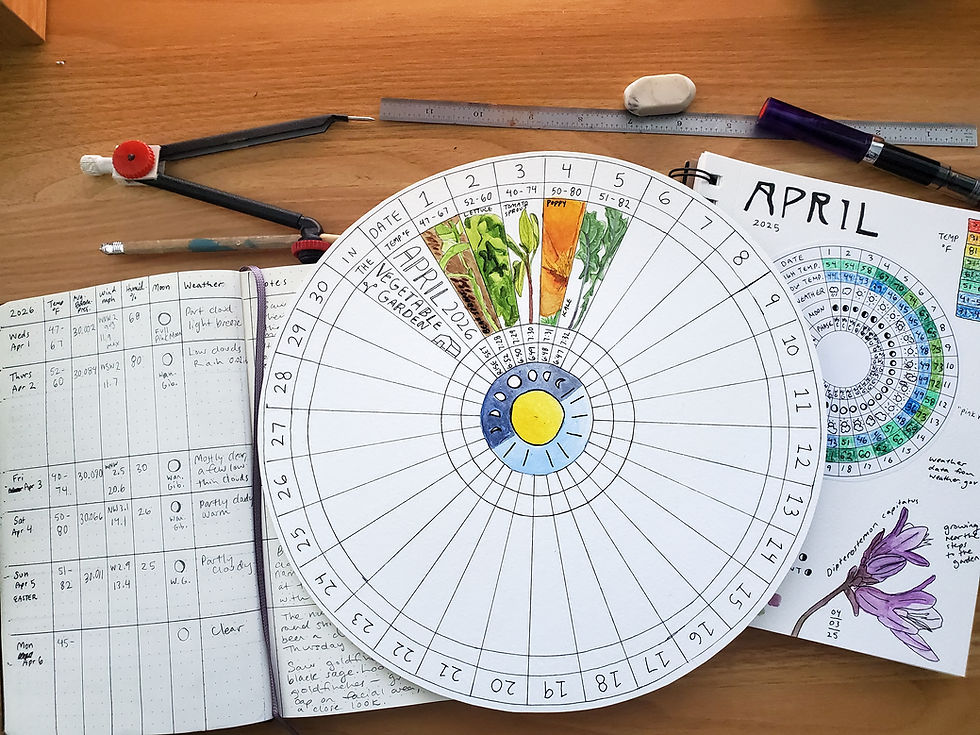
You’ll want to think about what kind of wheel you want to make and what information you want to record on it so you know how you want to divide up your wheel. For each month’s wheel I like to have a band for the dates around the outside, two inner rings for recording sunrise and sunset times, and a blank space in the middle. When dividing your wheel into 32 sections, the center gets too cramped to do much with anyways so it’s best to leave it open like this. You could add another ring on the outside for recording daily temperature, I did this the first month but decided not to continue with it. You can also get creative and record whatever info you want to! Moon phases, precipitation, you could even leave a section to use as a title for each day.

To make the wheel:
Place a light pencil dot in the center of your paper. Measure 5 inches away from that dot and make another dot (this is the radius).
Line up the stationary end of your compass (usually has a pointy end for holding it into the paper) with the center dot, and adjust the compass to reach the second dot.
Holding the center of the compass steady, draw a circle.
To make a smaller circle in the center, mark the radius like you did for the outer circle. I wanted my center circle to be 2 inches in diameter so the radius is 1 inch. To add rings for the sunrise and sunset times like on mine, make two more dots, 1.4 and 1.8 inches away from the center dot. With the compass in the center, one at a time make your three additional circles.
Next, divide up your wheel into 32 even sections. To do this, draw a straight line with your ruler through the center point, crossing the entire circle. Now your wheel is divided in half. Take your compass and set the stationary end on the line where it intersects the center circle. Stretch out the pencil end of the compass until it’s roughly halfway across one section and draw a curving line.
Now move it to the other side of the center line and do the same thing, so that you’ve draw two curving crossed lines in the middle of one half of the wheel (this is tricky to explain, if you’re a visual learner check out this video from Marion’s World on YouTube). Now place your ruler so that it lines up with the cross point of those two lines AND the center point of your circle. Draw a line through the circle. Continue dividing each new section in half like this until you have 32 sections.
You could also divide your wheel into 12 to make an entry each month, or into 4 for a seasonal wheel.
Go over your lines using the waterproof pen. Don’t worry if your hand isn’t steady drawing the circle, mine never is and I think it adds to the personal charm :) Remember not to draw through the center circle when drawing the lines in pen!
With the 32 slice wheel, you’ll have one or two extra sections depending on how many days are in that month. Use this for writing the month and any title or other info you want to include. You can also use the center circle for this, or make an additional picture or note there.
If making a wheel feels too daunting, there are printable wheels available online. Wheels of Time and Place is a great free resource for this. You could trace the wheel onto watercolor paper by taping the printed page onto a window and putting the watercolor paper on top so you can draw over the lines.
Now that you have your wheel, pick your theme and get started. In April I recorded things from my vegetable garden, and now in May I’m doing slices of the sky each day. You could collect drawings of feathers, rocks, or leaves. Tiny landscapes, skies, or track the life cycle of a plant. Get creative. You can draw, paint, or even write in each section. I’m just starting a four section seasonal wheel that will be color palettes from each season.

One of the coolest parts of making phenology wheels is being able to look back and compare previous years. I had a small phenology wheel that just tracked some weather data from April 2025 (shown above), and I was able to look back and see how different our temperature ranges were compared to this year. In 2025 there was a much smaller daily temperature range, averaging 10 degrees change, but in 2026 we had many days in April where the temp changed 30 degrees or more within a day.
I also love that even if the individual paintings aren't particularly "good", when you look at the wheel as a whole it looks beautiful. And it's great practice to improve my watercolor skills!
A phenology wheel is a small, daily commitment to noticing the world around you. It’s a great gateway project into keeping a nature journal, but is also a complete practice on its own. It’s so easy to get caught up in doing more and more these days, I like the relative simplicity of the phenology wheel and the consistency it’s brought to my nature journaling practice. It’s enough, just to do this.
Thanks for reading! If you enjoy the blog, consider supporting me through my online art shop.


Comments